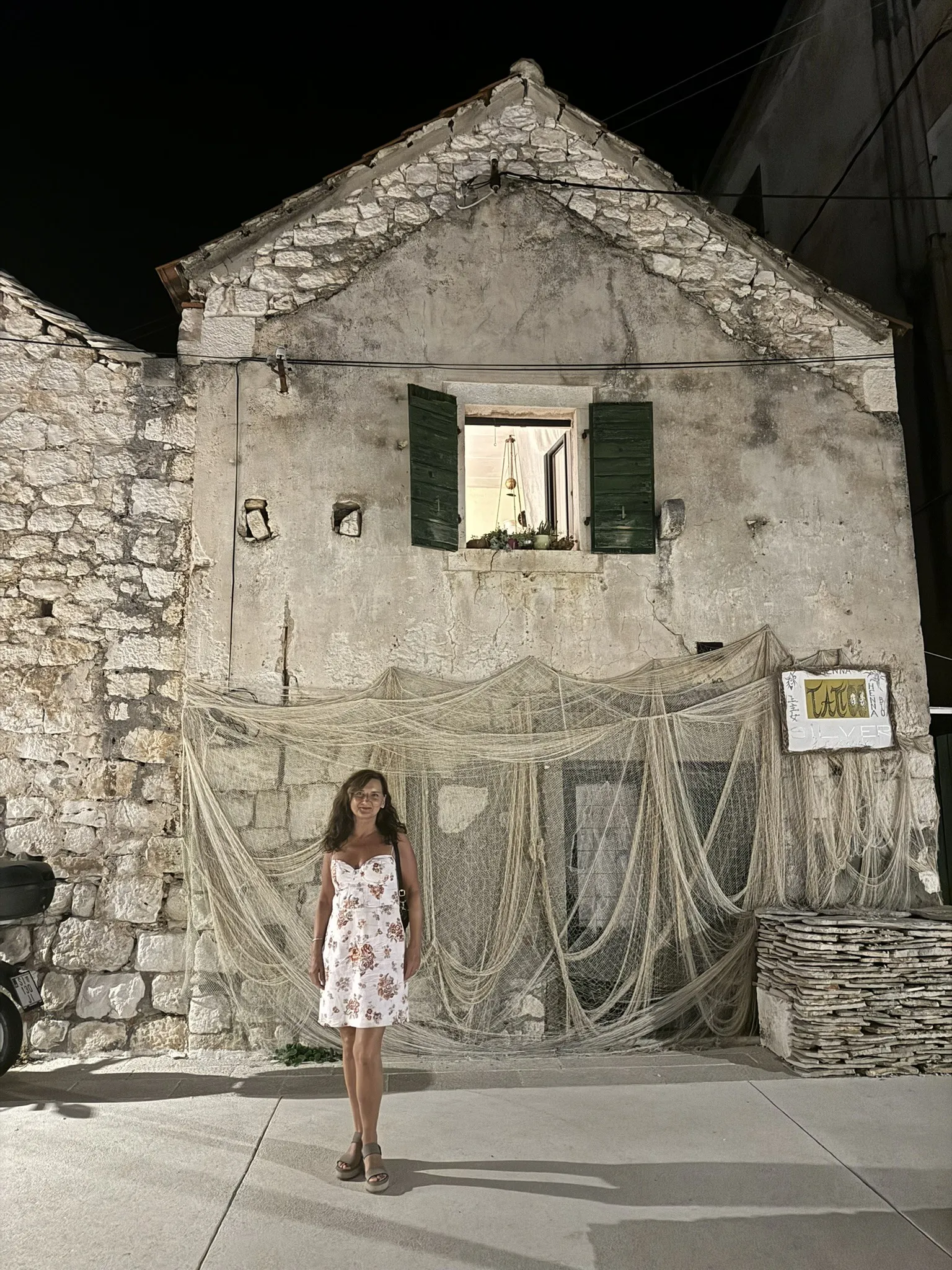
Monika Roglić
A painter and poet from Zagreb, Croatia, who lives and works in Austin, Texas.
Monika Roglić was born in Zagreb in 1968 and spent the summers of her childhood in Dalmatia, on the Adriatic coast. The red roofs above the water, the cypresses and stone chapels, the colour of the sea in sun and in the north wind — the landscapes of those summers are still the landscapes of her work.
In Zagreb she trained in education and worked for nine years as a kindergarten teacher, bringing art, psychodrama and music to children through the war years of the early nineties. In 1999 she left Croatia for the United States with her family, and in 2006 she graduated in psychology. Today she lives and works in Austin, Texas.
Painting, silk and poetry are, for her, one way of speaking. A painting becomes the design for a scarf or a dress, painted by hand on silk; a poem finds its colour on a canvas. What connects them is memory — of a city, a coast, a language — and the question of where one belongs when a life is lived between two worlds.
She has exhibited in the United States (2005–2009) and in Europe (2010), and writes in Croatian, English and German.
Contact
For exhibitions, collaborations, publications, commissions or enquiries about a work.
monika_roglic@yahoo.comAll contact details →The Painterly Poetics of Monika Roglić
into the water – the whole
world splashed me back.
Each and every thing is composed of opposites. Sometimes the tension of components pulling in different directions will be so strong that it leaves the mark of this restless coexistence upon the whole. So it is with art. The pleasure in the work of art is in large part the consequence of the elusive dynamics created by the coexistence of contrary elements – movement and stopping, full and void, warm and cold, the order of the rational procedure and the disorder of the impulsive gesture.
When she talks of herself, Monika Roglić says that she feels good in oppositions. Originating from the south, from the sea, but bound by her life's destinations to the inland of the continent, indeed of several continents, this professional psychologist and language expert, painter by vocation, reconciles the duality of the patterns of her life through her artistic expression. While her professional concerns connect her to the rational system of scientific discipline and the linguistic code, her painting, based on the emotion, is a reflection of a Mediterranean sensibility, a sensitive fragility and reminiscences of a childhood spent in south Dalmatia, that distinctive landscape of fruitful and succulent green, of fused blues of sea and the river that flows into it (salt and fresh) and sky (water and sky). No wonder then that colourism is the main determining feature of Monika's painting and that in motif it is connected mainly with the Mediterranean landscape and floral compositions.
In spite of the reduction of form, the figural is a constant in her dense applications of paint. The motif of a serried row of little houses with red roofs, the local waterfront and the sea lit up with the glow of the sun or choppy and dark as a result of the north-east wind alternates with recognisable visions of real towns. They are created on impulse, they emerge from the gesture, are a materialisation of the painter's feelings and deep connection with the clime in which she finds the foundation of her own identity and the reasons for her personal inclinations.
In paintings with compositions of flowers, the colourism is even more intense. Not only does Monika expand her anyway lavish palette but she also takes a further step, into a new medium, painting on silk. This technique has its own laws and requires different discipline. And here we are again in the area of contrasts. Monika transposes the acrylic impasto into painted fields of lively hues on silk. She replaces the strong, coarse texture of canvas with the new and yielding material. Instead of rapid, impulsive gestures, it is now strictly controlled strokes that are at work. Emotions are channelled via patience. Carefully, with dedication, taming the hand and the buoyant imagination, she produces her floral creations. She addresses her work as the generations of women before her sat down to their needlework. But she has not just replaced her painter's canvas with silk for she has also decided on painting dresses, the lines of which are pared down to the basic construction of the pattern. The more successful is the combination of simple form and opulent colourist decoration.
The painted dresses of Monika Roglić, just like her canvases, are an expression of uninhibited emotion. And they are also a reflection of the artist's identity, constructed through a network of concepts brought into semantic unity by the name of Mediterranean.